
Skip to content
The teal Websites house with its gold WWW mark connecting publishing, analytics, forms, and checkout

The website side of your realm

Your website. Working for you.
Your code. Your rails.

Import the site you have or describe the one you need. Keep the code in your GitHub, then run SEO, blogs, lead forms and social posts from your realm, with routines on autopilot.

01Own your code02SEO and blog03Lead inbox04Product catalogue

Websites that run themselves

Everything a site needs to earn its keep, in one dashboard.

Launch it, lift it in search, publish the blog, answer every lead, and keep the source in your own GitHub. Turn on only the parts you need, and let routines run the rest.

01

SEO suite

Know exactly what to fix, and why it matters.

The SEO tab audits your site, tracks the keywords you want, and watches what your competitors rank for. It also stores your buyer personas, their pains and their desires, so every fix is aimed at a real customer instead of a vanity score.

  • Site audits with ranked actions
  • Keyword and competitor tracking
  • Buyer personas with pains and desires
  • Search Console sitemap and indexing
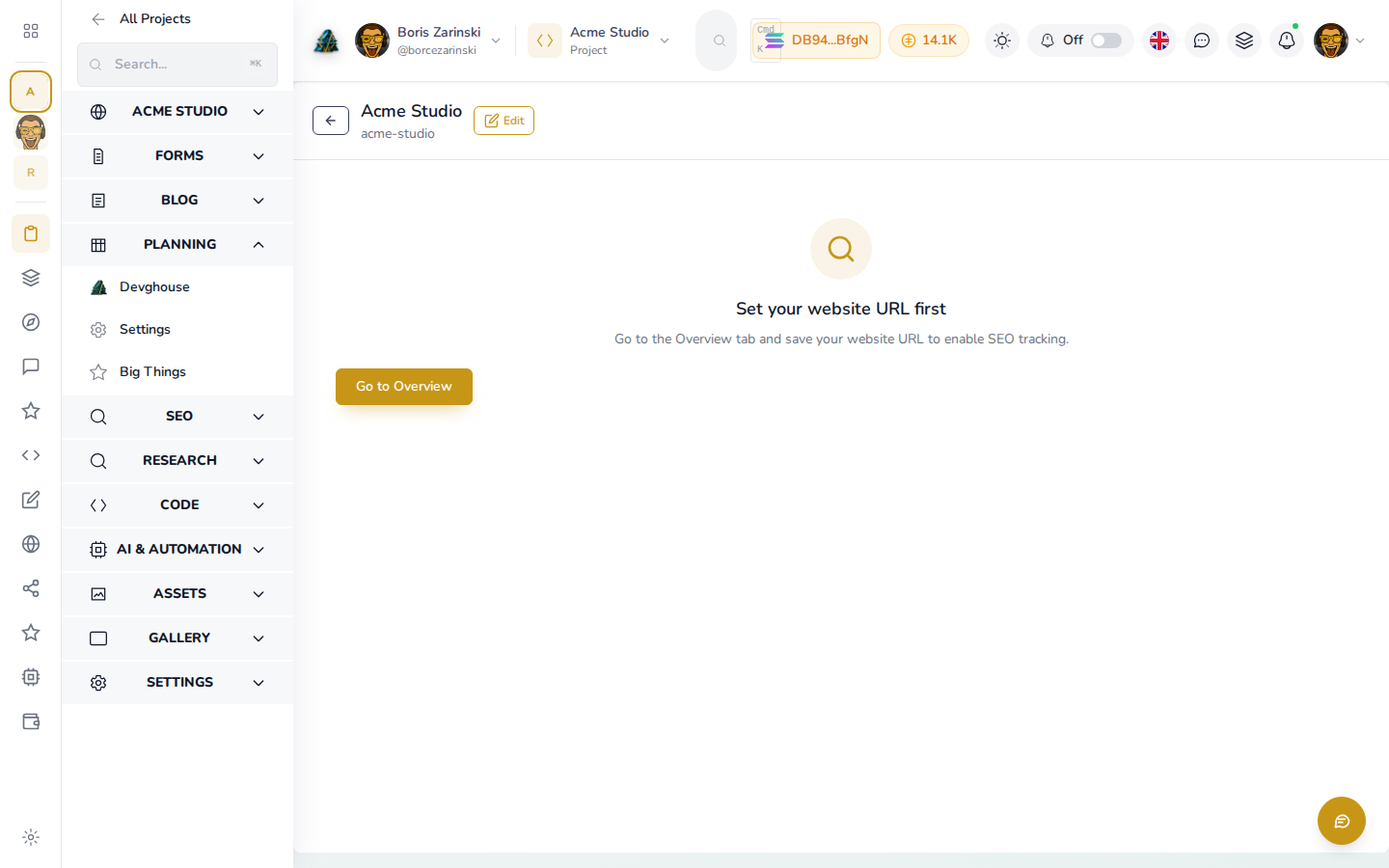
The Keywords section before a website URL is saved
Your keyword tracking, ready to switch on once your website URL is saved.
02

Performance

Catch a slow page before your visitors feel it.

Performance runs the platform's own Lighthouse engine on demand and on a schedule, no third-party account, and keeps the history. You see the trend, not a single snapshot, so a page that gets heavier over time shows up while it is still cheap to fix.

  • Lighthouse runs on demand
  • Scheduled checks with full history
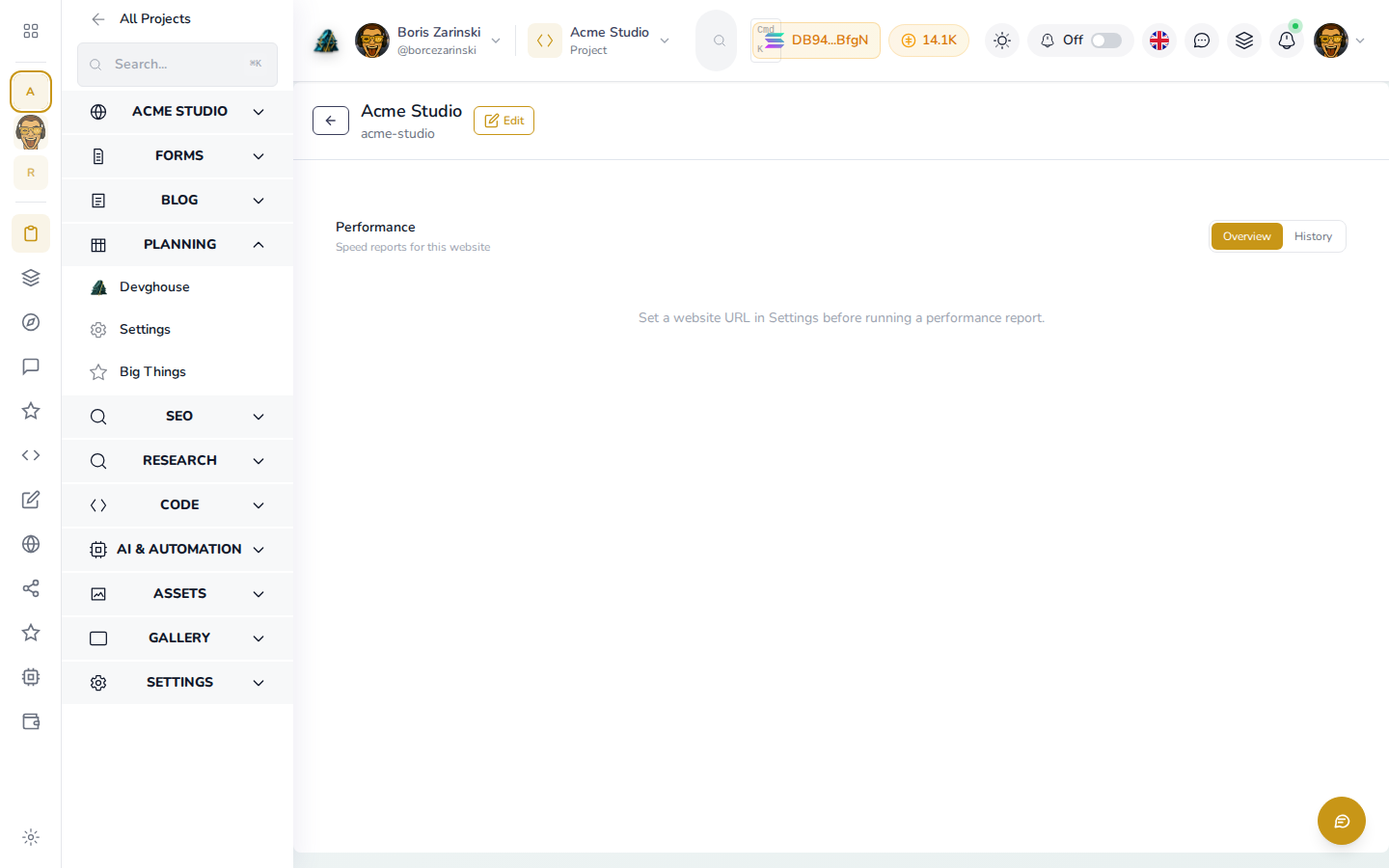
The Performance section, ready to run once a URL is set
Your Lighthouse history, ready to run once your website URL is set.
03

Blog autopilot

A post a week, without you writing it.

Autopilot finds the topics worth covering, drafts the post, schedules it, and tweets it when it goes live. Your blog stops dying the moment the quarter gets busy, and your keyword research finally turns into shipped pages.

  • Topic discovery from your keyword gaps
  • AI drafts you review and edit
  • Scheduling with auto-tweet on publish
  • Bring an existing WordPress or Squarespace blog
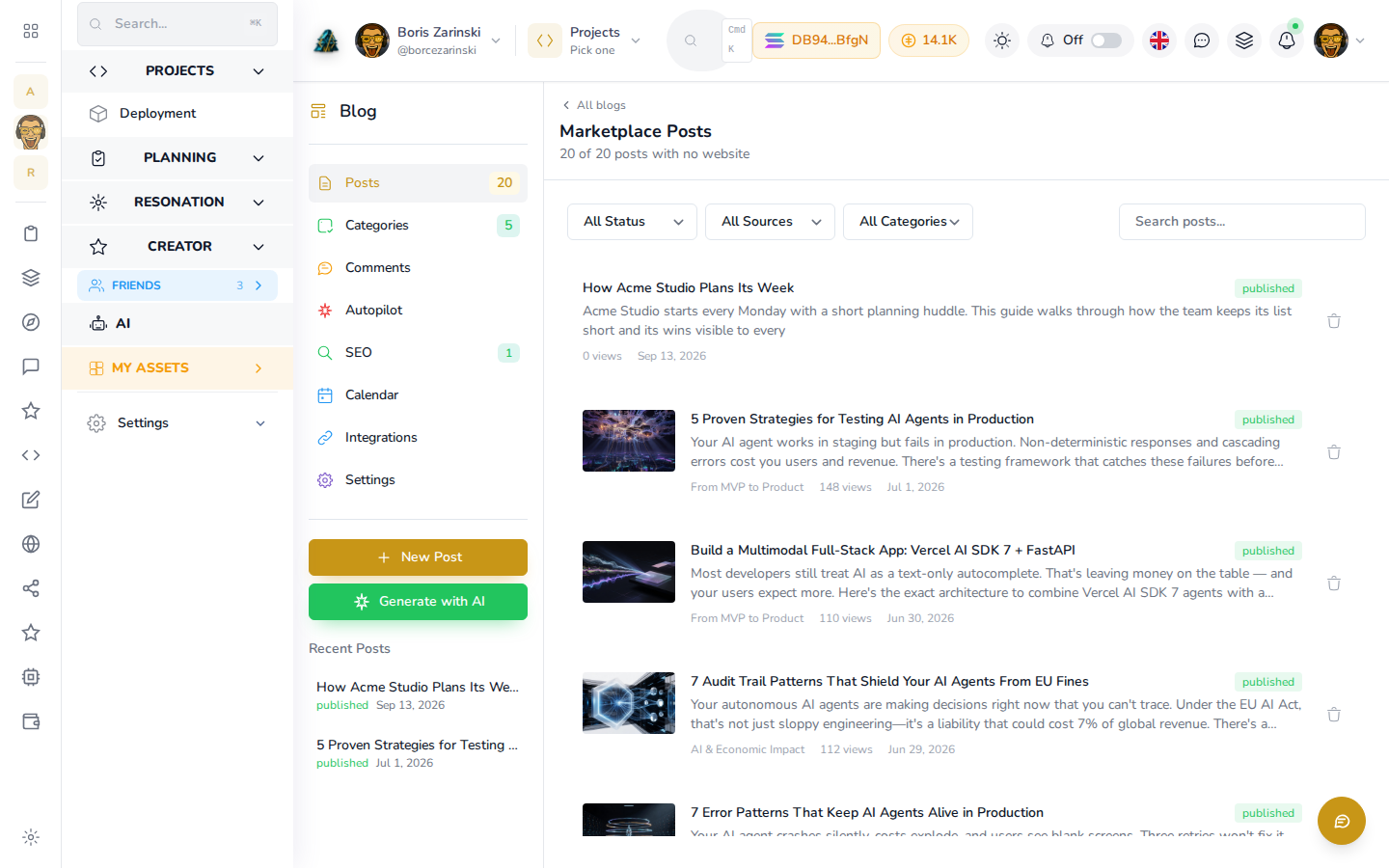
The blog post list with draft and published content
Drafts, scheduled posts, and published stories in one list.
04

Forms and the lead inbox

Never lose a lead again.

Build the forms your site needs, and every submission lands in one inbox instead of an address nobody checks. Reply from the same screen with saved email templates, so a new enquiry gets an answer the same day.

  • Build any form your pages need
  • One inbox for every submission
  • Reply in place with saved templates
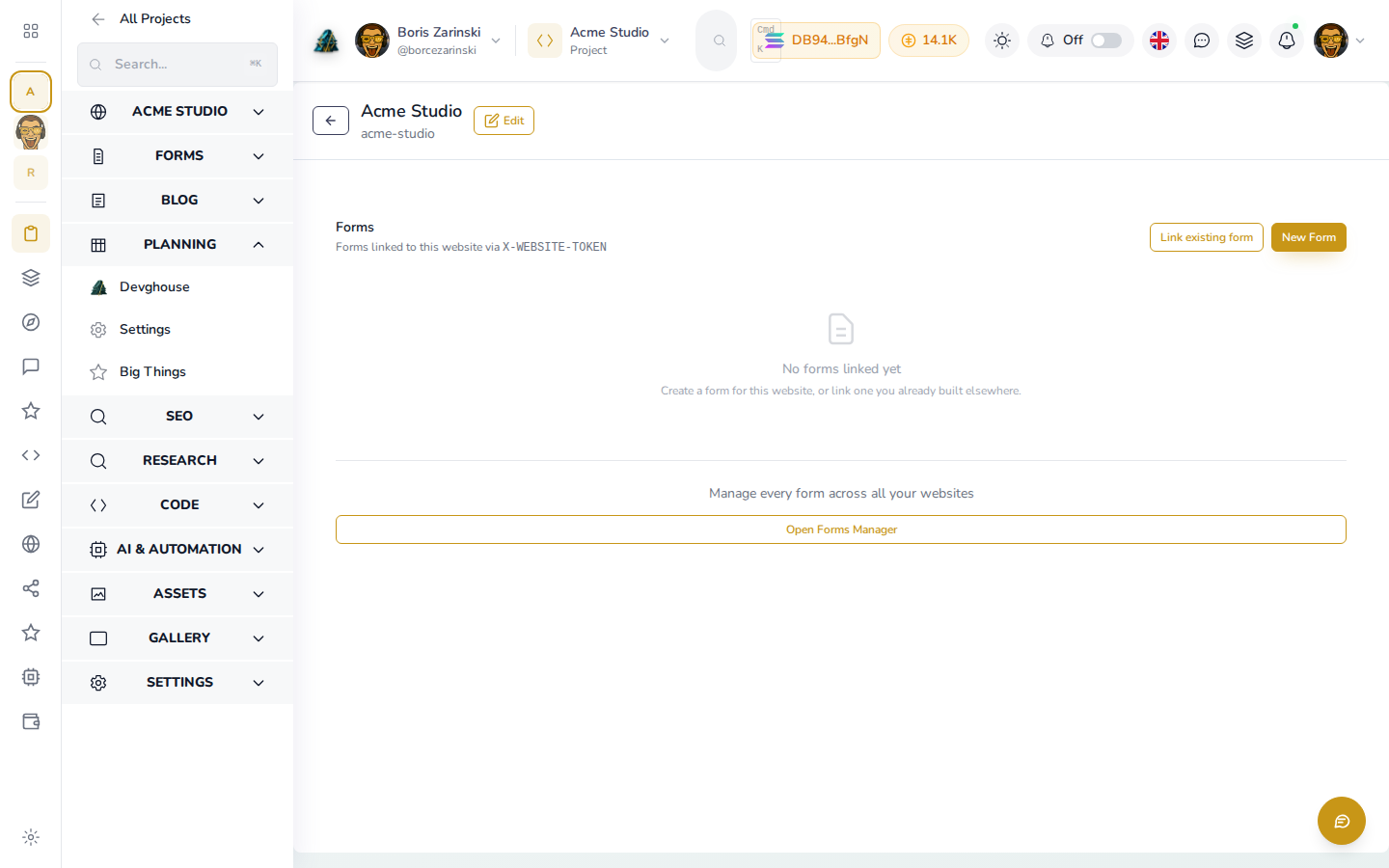
The Forms section with a submission inbox for a website
Every submission waiting in one inbox, before your first form even goes live.
05

Retail & Online stores

Sell from the same site, without the app tax.

Run a product catalogue with image galleries, descriptions, and pricing served straight from the platform. Your catalogue, your SEO, and your blog stop living in three disconnected tools. Point the bulk image fetcher at the catalogue and product photos fetch themselves, stoppable mid-run, while AI drafts the descriptions you never had time to write.

  • Product catalogue with galleries and pricing
  • Bulk image fetcher across the whole catalogue
  • AI-drafted product descriptions in bulk
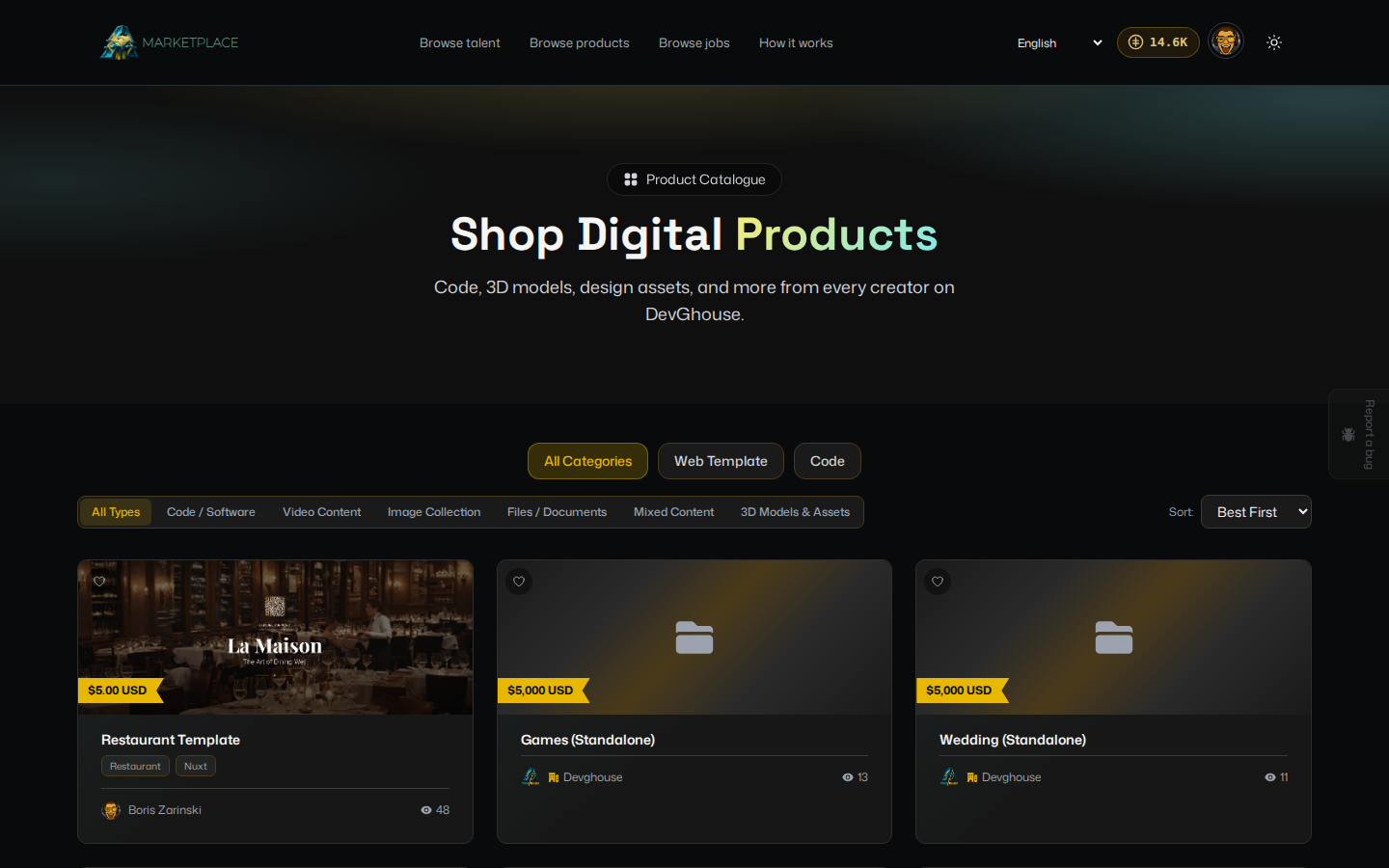
The product catalogue in the DevGhouse workspace
A product catalogue managed from the same workspace as the site.
06

Testimonials

Put your proof where buyers look for it.

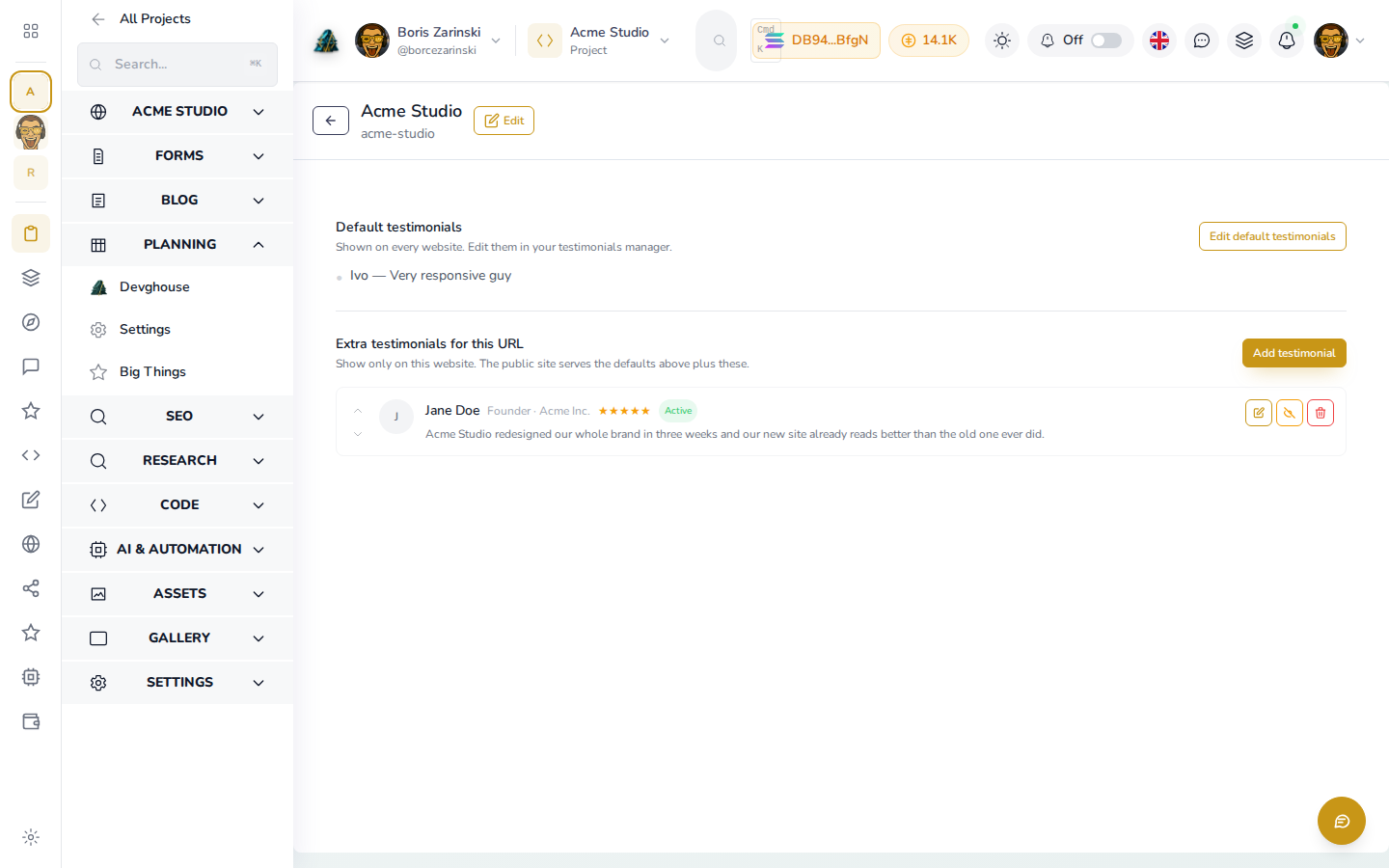
Collect the kind words you already get, order them the way you want, and serve them straight to the live site. No plugin, no extra subscription, no copy and paste into a template.

  • Manage and reorder in the dashboard
  • Served live over your website token
A testimonial being added for a website
A testimonial added and ready to show on your live site.
07

Team

Show the people behind the business.

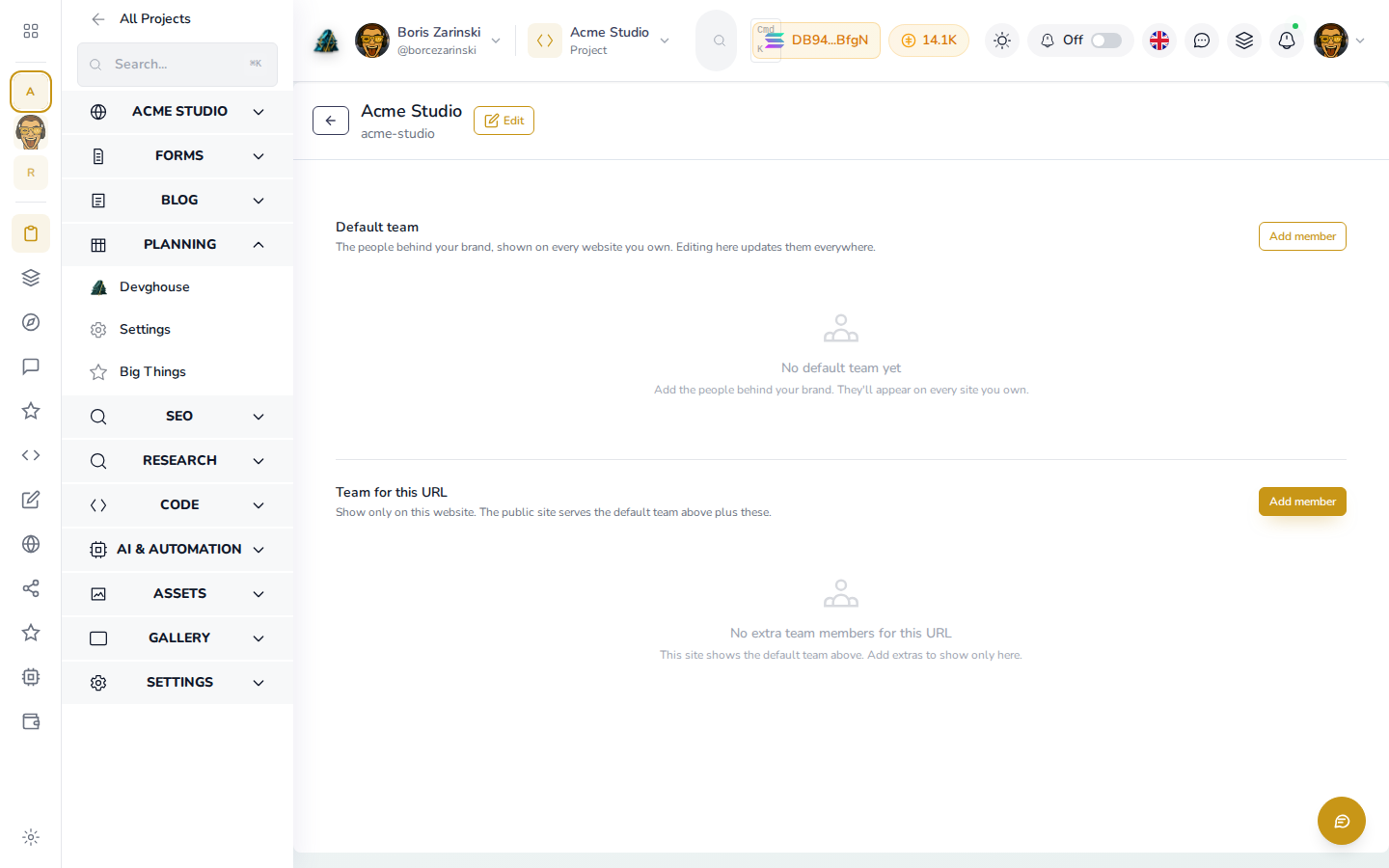
Your team page is a dashboard list, not a code change. Add a person, reorder the lineup, and the live site updates itself the next time a visitor loads the page.

  • Add, edit, and reorder people
  • No deploy to publish a change
The Team section ready for a first member
Your team roster, ready for its first member.
08

Brand control

Your look, everywhere, at once.

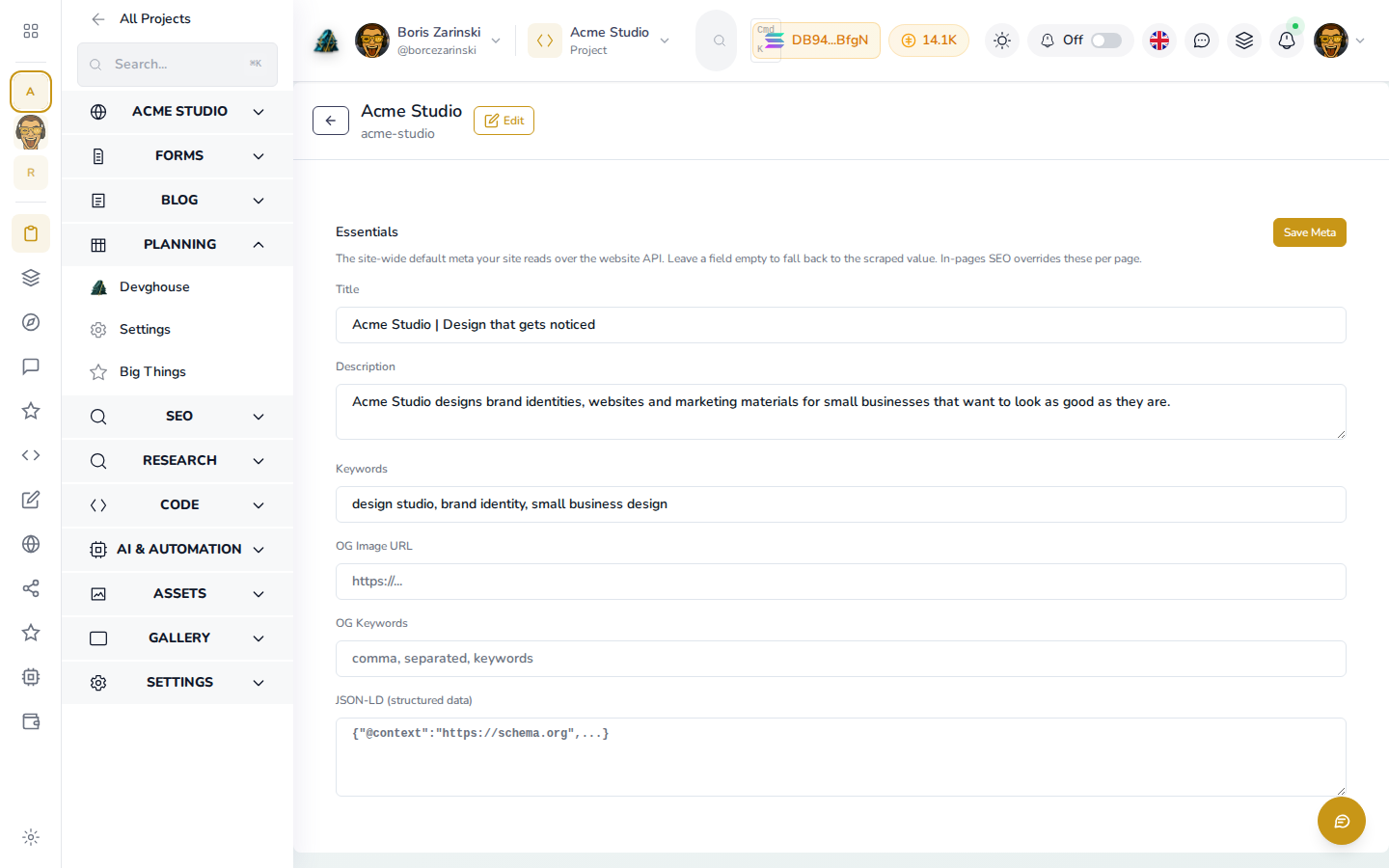
The Brand tab is the one control point for your favicon, avatar, logos, and hero art, with light and dark paired so both themes look deliberate. Upload once and the live site picks it up with no deploy.

  • Favicon, avatar, and portrait or landscape logos
  • Hero image and video, light and dark paired
  • Served live over the brand payload
Website essentials and brand settings in the dashboard
The site essentials and brand settings kept together.
09

Assets and CDN

One home for every file your site serves.

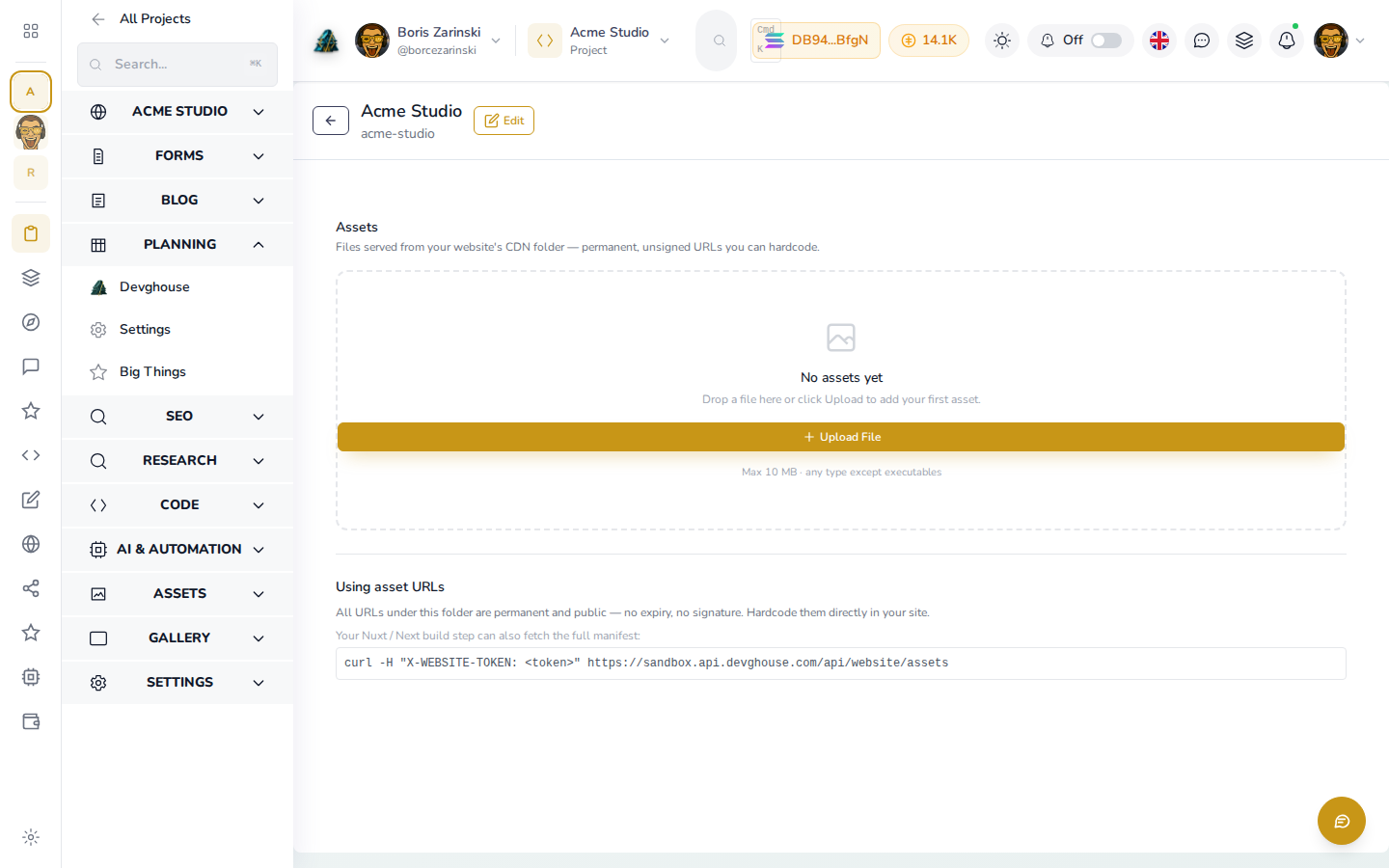
Each site gets its own CDN folder to upload, browse, and delete the images and files it uses. Your media lives beside the site that serves it, not scattered across a laptop and three cloud drives.

  • Upload, browse, and delete in place
  • A CDN folder scoped to this site
The Assets section ready for a first upload
Your site’s own CDN folder, ready for your first upload.
10

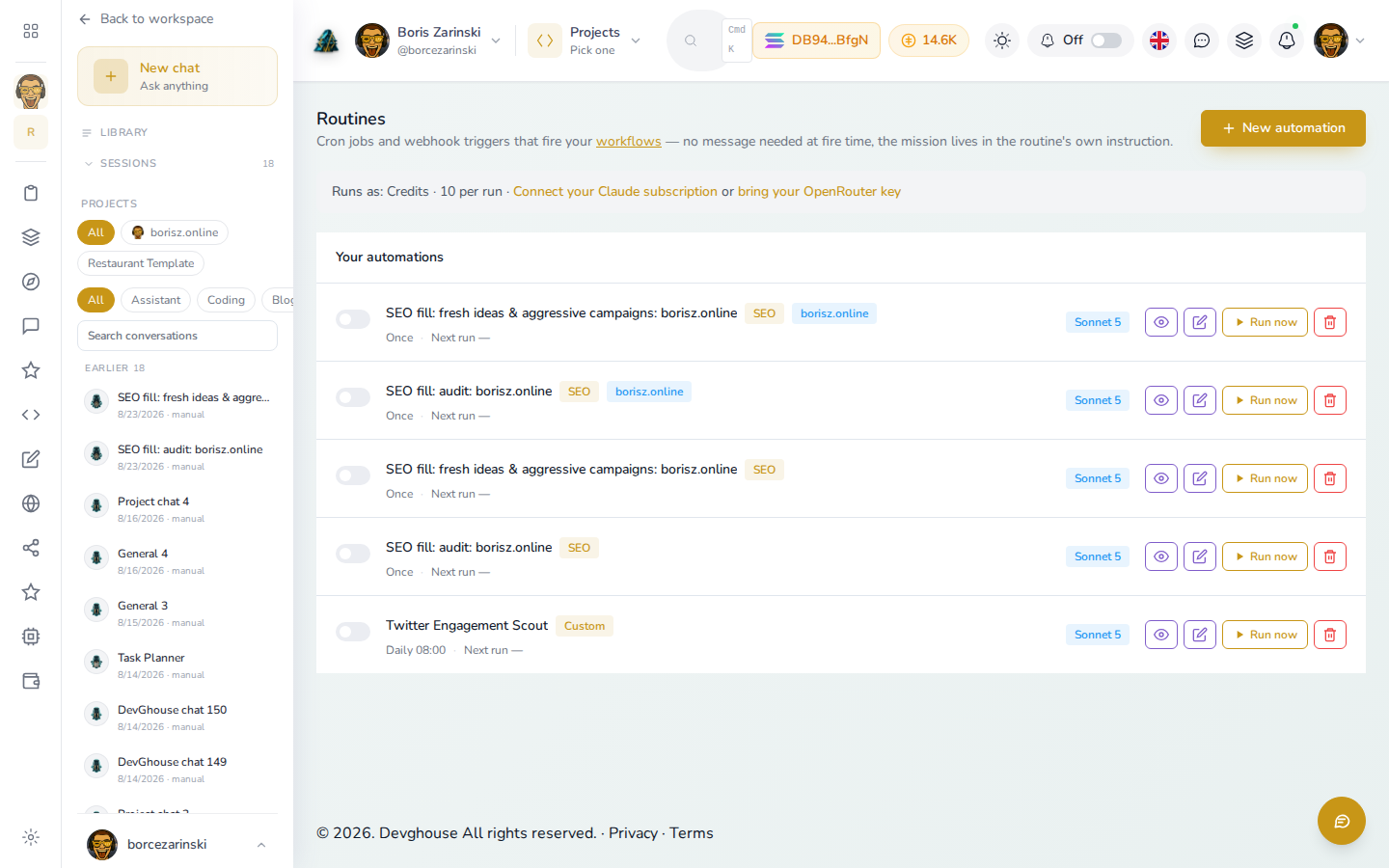
Routines

The site maintains itself, and proves it did.

Bind routines to a site and the SEO refresh and blog autopilot run on their own schedule. Every run is logged, so when a client asks what the maintenance actually paid for, you open the audit trail instead of arguing.

  • Scheduled SEO refresh and blog autopilot
  • A logged run for every action
  • An audit trail per client site
The routines list in the DevGhouse workspace
Scheduled routines listed with their status and next run.
11

Autonomous

The site that files its own fixes.

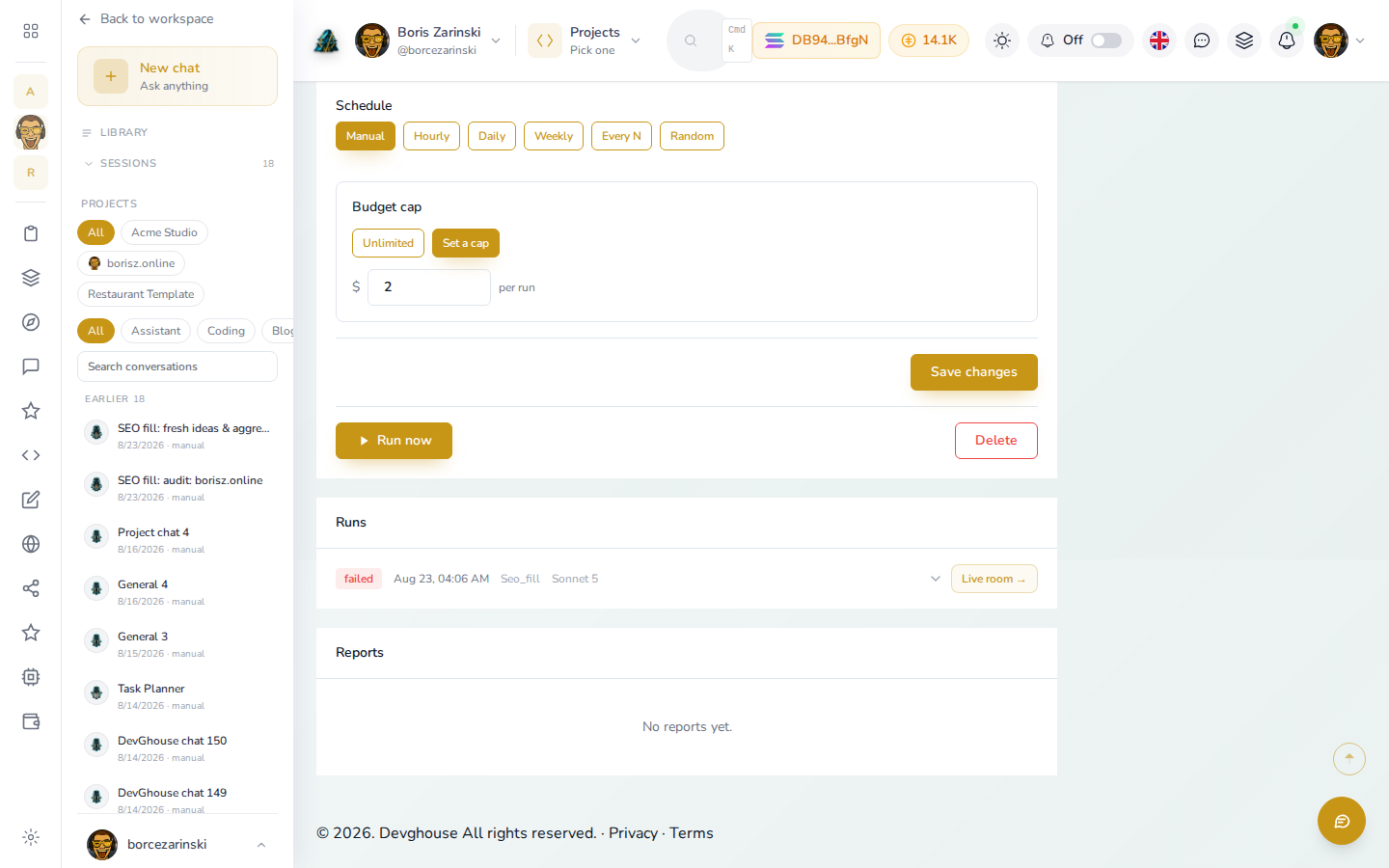
Audits do not stop at findings. A slow page or a dropped ranking becomes a task, a routine picks it up at its scheduled time, and a real coding agent fixes it and pushes, with the run logged so you can see exactly what was done and why. That is the difference between a report and a result.

  • A performance finding at 2am, a merged fix by 9
  • SEO audit actions applied on schedule
  • Every run logged, every change traceable
  • You set the rhythm, the site does the work
A routine detail screen with its schedule and run history
A routine schedule beside the run history it produces.
12

Code and GitHub

Your code stays yours, in your own account.

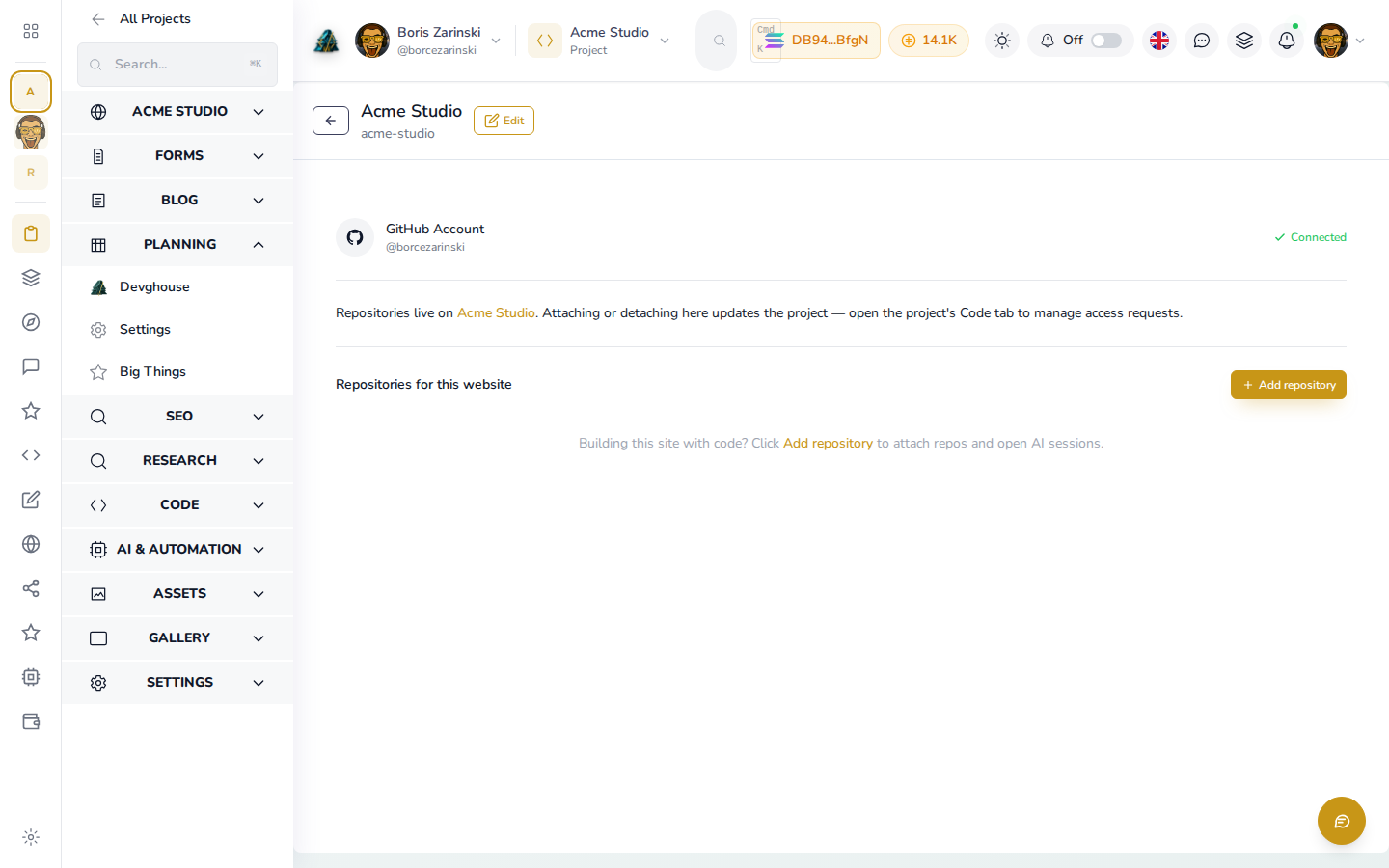
A new build lands as a private repository in your own GitHub, and you can link one or many repos with a role per repo. Teammates request access instead of sharing a password, and your exit is always one git clone away.

  • Private repo in your own GitHub account
  • Link many repos, one role each
  • Teammates request access in place
The Code section with a GitHub account connected
Your GitHub account connected, with a role for every teammate.
13

API token

Your site reads its own content, safely.

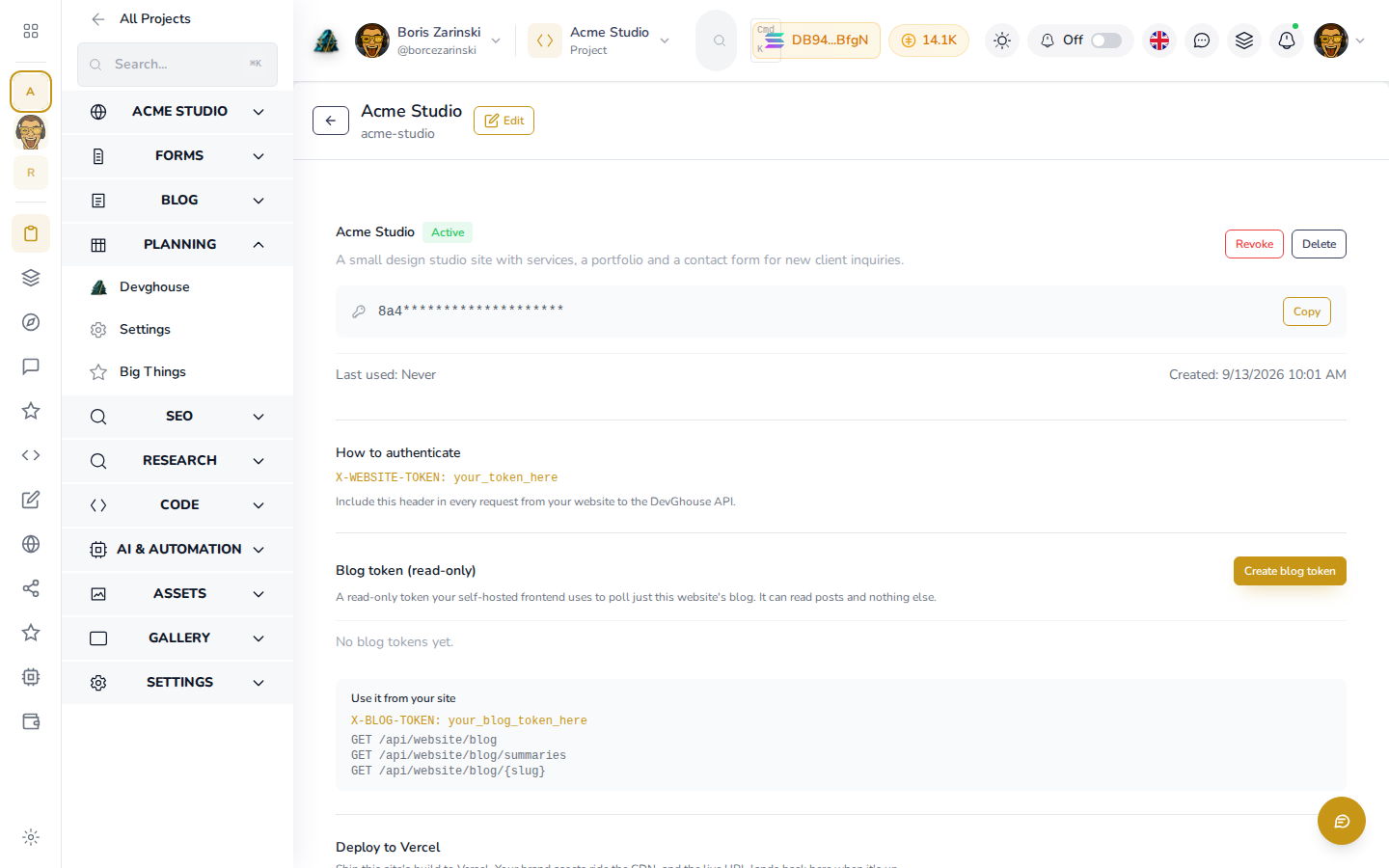
Every website gets a read-only token, and that is what the live site uses to pull its meta, blog, forms, and products. It can read your content and nothing else, so publishing is never a security trade.

  • Read-only by design
  • Feeds meta, blog, forms, and products
A website’s API token panel
Your website’s own read-only token, masked and ready to use.
14

Settings and domains

Run it on your own address, with only the parts you want.

Settings is where the site URL, the capability toggles, and your Google tag live. Connect a custom domain, verify it by DNS, and turn SEO, blog, or GitHub on and off as your needs change.

  • Custom domain with DNS verification
  • Capability toggles for github, seo, and blog
  • Google tag in one field
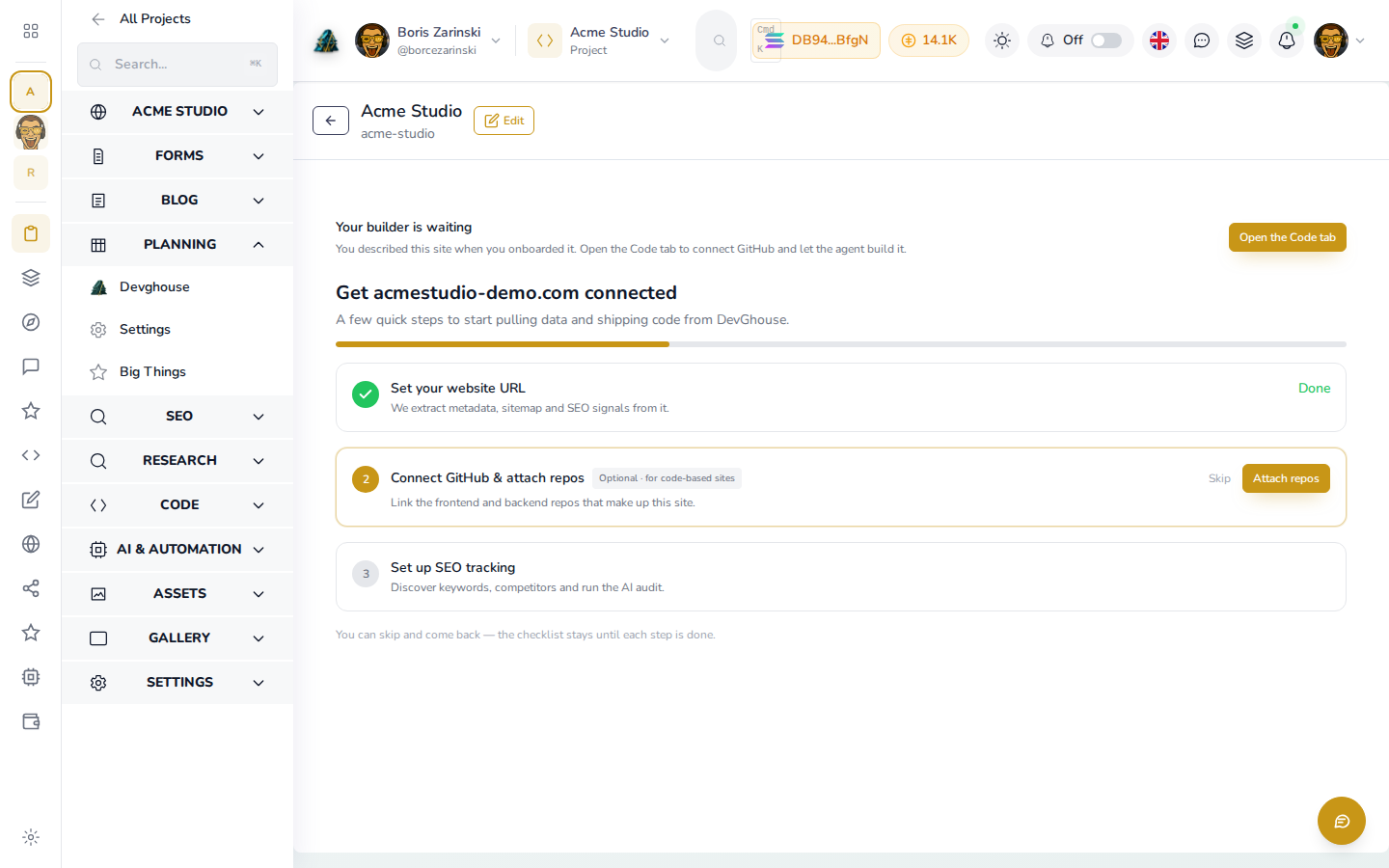
A website connection checklist in the dashboard
The connections a website needs, checked in one place.

Bring the site you already have

Point us at your old site. We import it, modernize it, and keep it current.

Paste a URL and Websites pulls in your pages, brand, and copy, then rebuilds them on the platform. Your site stops aging the day you connect it, and stays current from then on.

Import a URL

Before and after

Your old site

Aging pages, no analytics, last touched years ago.

On DevGhouse

Same content, modernized, with SEO, a blog, and lead forms kept current for you.

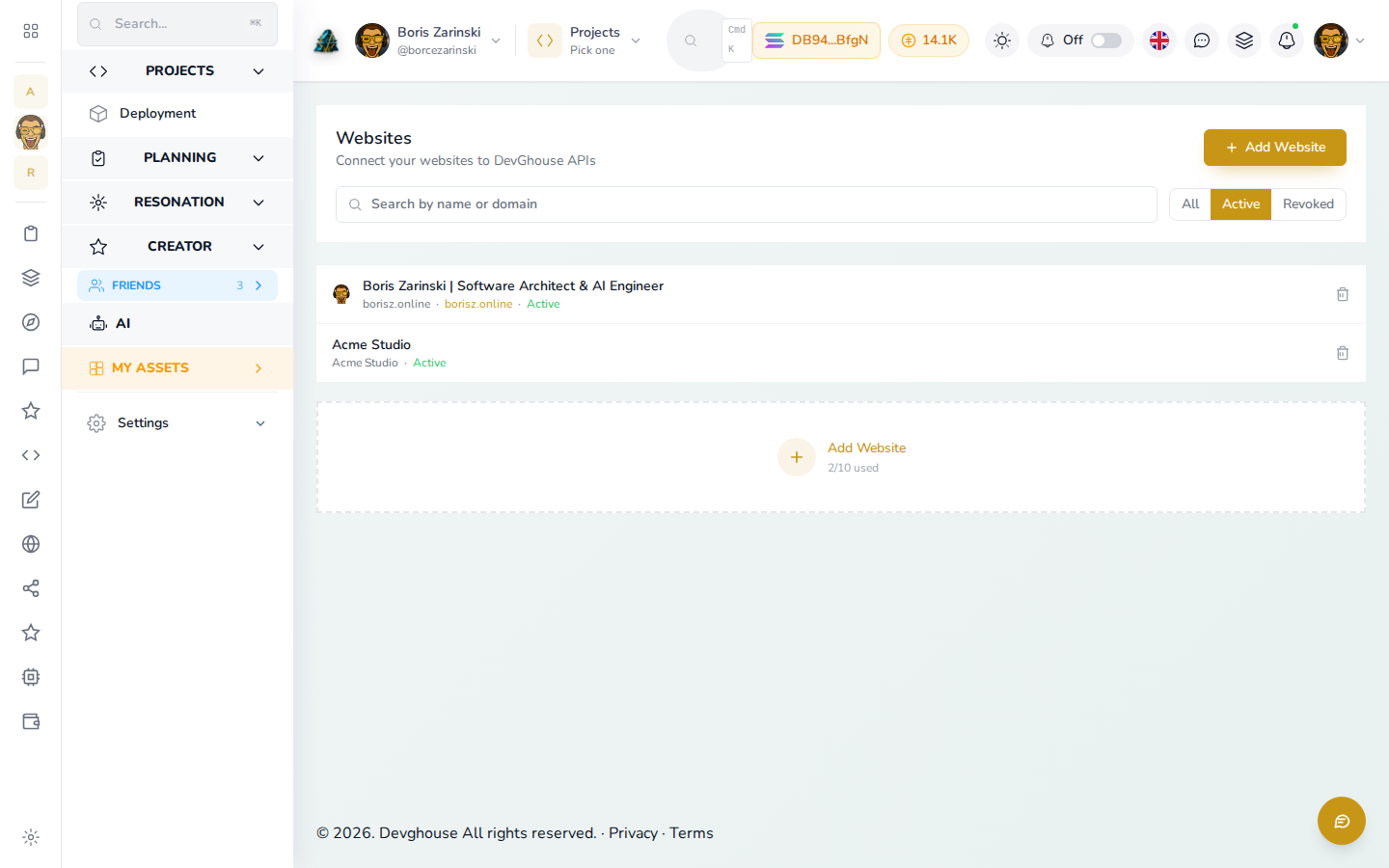
The Websites dashboard list showing a newly connected site
Your site, connected and listed in your dashboard within minutes.

Two ways to build

Static

Generated from your details into a private GitHub repo you own and host anywhere.

Database-driven

Wired to the platform rails, so the dashboard and routines keep editing it live.

The static versus database toggle is arriving with the builder's first full slice. Today, a new build lands as owned source in your GitHub.

Build it your way

Describe a new site and get real, owned source.

The builder writes your site straight into a private GitHub repo in your own account, so the code is yours from day one. Choose a static build you host anywhere, fully disconnected from DevGhouse if you want, or a database-driven site the dashboard and routines keep editing.

Describe a site
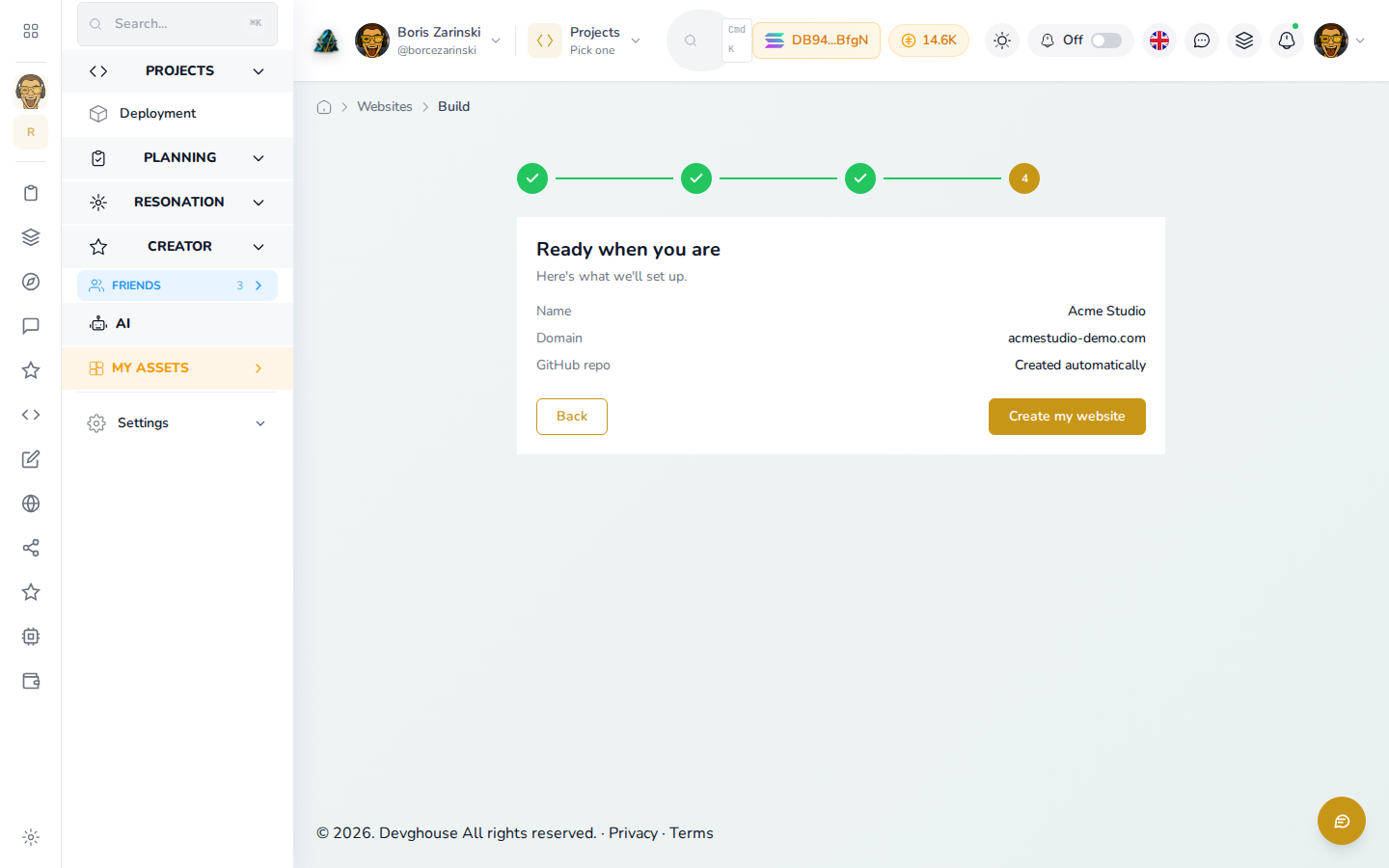
The build wizard's review step before creating a new website
One last review, then your code lands in your own GitHub.

Bring your own AI

Your AI account builds it. Or ours does.

Every build and routine runs on one of four lanes. Connect your own Claude, Codex, or Kimi subscription and a run costs a flat 1 credit - your own plan pays the provider directly, the credit pays for the orchestration. No AI account? The DevGhouse Proxy needs nothing and is metered at real provider cost × 1.5. Failed runs always charge 0.

Your account

Claude Code

Connect your own Claude subscription via the native OAuth device flow. Runs execute as your own account.

Flat 1 credit per successful run - 0 on failure

Your account

Codex CLI

Bring your own OpenAI/ChatGPT account. Runs execute as your own account.

Flat 1 credit per successful run - 0 on failure

Your account

Kimi CLI

Bring your own Moonshot/Kimi account. Runs execute as your own account.

Flat 1 credit per successful run - 0 on failure

No account needed

DevGhouse Proxy

Nothing to connect - pick it and go. Metered at real provider cost x 1.5, charged in credits.

Real provider cost x 1.5 - 0 on failure

$1 = 100 credits - one credit balance across every DevGhouse app.

Integrations

Connect everything you use.

Your site keeps talking to the tools it already relies on. Each connection below belongs to a real Websites, SEO, Blog, or Code path.

Need a different tool? Ask us to connect it, and larger setups get a clear quote first.

Start your website

Operator-managed pricing

See access and credit costs before work starts.

The operator controls Websites access and every metered action. This page reads those values live, so it does not promise a made-up plan or price.

One-time entry

$50

Includes 5,000 credits

$1 = 100 credits

Start your website

Ready when you are

Start with a URL or a sentence. Add the rest when you need it.

Every path creates a real website record in your dashboard. Onboarding is free to start, and access plus credit costs always show before any paid work begins.

Start your website

Common questions

Know what you can manage today.

Do I need to know how to code?+

No. You can bring an existing website or describe a new one in plain language. The dashboard manages its content, SEO, blog, forms, and other tools.

Who owns the code?+

You do. A new build creates a private repository in your own GitHub account, and you can link one or many repos with per-repo roles from the Code tab.

What SEO tools are connected?+

DataForSEO powers audits, keywords, backlinks, competitor checks, and rankings. The platform's own Lighthouse engine handles performance checks. Google Search Console and Google Ads provide search and campaign data.

Where do form submissions go?+

They land in the Forms submission inbox for that website, where you can review and reply to them with saved email templates.

Can I sell products from my site?+

Yes. A site can run as a storefront with a product catalogue, image galleries, and pricing managed from the same dashboard.

Can the site keep itself current?+

Yes. Routines bound to the site run SEO refreshes and the blog autopilot on a schedule, so the work continues after launch.

Choose your starting point

Bring the site you have, or describe the one you need.

Both paths create a real website record in your DevGhouse dashboard. Your source stays in your own GitHub when you connect a repository.

Keep it working

Your website should keep helping after launch day.

Start with a URL or a plain description. Add SEO, a blog, forms, and source control from the same dashboard when you are ready.

Start your website